
The Rackable Cambered Spider Bar
Two bars worth of work in one piece of equipment.
The first time I touched a specialty bar for squatting, I thought it was for guys who couldn't handle a straight bar. That was a wrong opinion. It took about one set at 315 pounds to figure that out.
The story with the Safety Squat Bar goes like this. I had recently squatted 760. Walked into the gym, loaded 315 on the SSB, and figured it would be a warm-up at worst. My lower back lit up as I'd never felt before. My upper back caved. My eyes started watering somewhere around rep two. The other guys in the gym, guys who squatted considerably less than me on a straight bar, were moving through the same weight like it was nothing.
That experience taught me something that took years to fully understand. The muscles you think are working during a squat and the muscles that are actually working are often two different conversations. Specialty bars don't hide weakness. They find it and put it on display.
The second bar that mattered was the cambered squat bar. If the SSB exposed the upper back, the cambered bar exposed everything else. The weight swings. The bar moves independently of you. Getting to the hole is one thing. Coming out of it with the weight trying to pull you in four directions is a completely different problem. That instability forces a level of tightness and core control that no straight bar will ever replicate. The people who get strong with the cambered bar tend to be very hard to miss under a straight bar.
Those two tools built a lot of strength in a lot of lifters over a lot of years. The question we kept getting was whether you could get the benefits of both without having two separate specialty bars taking up rack space and budget. The Rackable Cambered Spider Bar is the answer to that question.
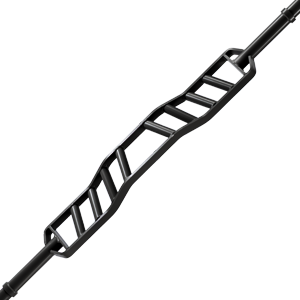
This bar combines the SS Yoke Bar and the Rackable Cambered Squat Bar into one piece of equipment. You get the handle positioning of the yoke bar, which removes the need for your hands to grip a straight bar behind your back, combined with the drop and instability of a cambered bar. The result is a bar that is harder to use on its own than either of its predecessors.
Quick Specs
- Weight
- 80 lbs
- Length
- 86 inches
- Rack Compatibility
- Standard power rack
The handle design is the first thing you notice. Because your hands hold the handles rather than gripping a straight bar across your traps, your shoulders are not locked into external rotation under load. For anyone who has trained long enough to develop shoulder issues, that distinction matters enormously. You can step under this bar and get into your squat without the grinding, without the pre-set discomfort, without spending ten minutes trying to find a grip width that doesn't make your shoulder feel like it's tearing. Your shoulders are in a neutral position. They stay that way through the entire movement.
That alone has kept a significant number of lifters in the sport longer than they would have made it otherwise.
The handle design keeps your shoulders in a neutral position through the entire movement. That alone has kept a significant number of lifters in the sport longer than they would have made it otherwise.
But here's what the yoke bar portion of this design does not do: it does not push you forward. The handles are not the forward-angled yoke. This is a cambered bar with handle positioning. The drop of the bar means the weight is lower than your hands. That changes everything about how the load sits on your body and how you have to control it.

The lower center of gravity forces your upper back and core to work harder to keep you upright. On a straight bar, your body has a relatively direct relationship between where the bar sits and where the weight is. With a cambered bar, the weight is hanging below the bar's contact point. The moment you get sloppy with your upper back or let your midsection go soft, that weight starts to move in directions you did not intend. Tightness is no longer optional. It becomes the only way to function.
This is why people who train consistently with the Spider Bar come back to a straight bar and find it relatively manageable. The control, the tightness, the upper back engagement that this bar demands carry over directly to the competition squat. You've trained the supporting muscles under conditions that made them work harder. That adaptation shows up.
On stability: The Spider Bar's design keeps the weight more securely in place than a traditional cambered bar. You still get the instability that builds core activation and upper back strength. You get less of the excessive swing that turns a training tool into a balance problem. It's a more controlled environment for developing the qualities that matter.
Squats are the obvious application and the primary reason most lifters pick up this bar. Low bar, high bar, box squats, suspended squats. The shoulder-friendly handle position makes it accessible to lifters who have had to modify or avoid straight-bar squats due to shoulder or elbow issues. The cambered design makes every variation more demanding and more effective at building posterior-chain and midsection strength that supports a big squat.
Good mornings are the second major use case. The Spider Bar is exceptional for good mornings, including suspended, walking, and arch-back variations. The lower center of gravity changes the stimulus significantly. The weight creates a more dynamic demand, forcing the hamstrings, glutes, and lower back to stabilize throughout the range of motion, unlike a straight bar.
- Low bar, high bar, box squats, and suspended squats
- Suspended good mornings
- Walking good mornings
- Arch-back good mornings
- Walking lunges with controlled load path
If you need to keep training your lower body with heavy loads while managing a shoulder issue, this bar gives you that option without compromise. You are not doing a modified version of the squat with reduced loading or restricted range of motion. You are squatting, with the same demands on the legs and posterior chain, without placing your shoulders in a position that aggravates an existing problem.

That needs to be said directly because it is true and because it matters.
The first time most lifters step under the Spider Bar, they are not prepared for how demanding it is. The weight feels different than a straight bar, even at percentages that would otherwise feel manageable. The upper back demand comes on fast. The core engagement is immediate. The combination of the cambered design and the handle positioning creates a training stimulus that most people have not encountered before.
That is not a reason to avoid it. That is exactly why you should use it.
The lifters who struggle the most with this bar in the early sessions tend to make the most significant gains from it over time. The weaknesses it exposes are real weaknesses. Addressing those weaknesses through consistent work with the Spider Bar builds the foundational strength that a straight bar alone was never going to develop.
You become harder to beat in the hole. Your upper back holds its position when everything gets heavy. Your midsection stays rigid when the weight tries to pull you forward. Those qualities matter in competition and for longevity.
If you are a competitive powerlifter dealing with shoulder or elbow issues that have made straight-bar squatting difficult or painful, this bar is worth your attention. You do not have to take time away from squatting to let your shoulders recover. You can continue squatting, continue loading the movement, and continue developing strength without placing your shoulder in the position that causes the problem.
If you are a lifter who wants to build posterior chain strength and core stability that carries over to the competition squat, this bar will do that work. It is not a replacement for the straight bar in your training. It is a supplemental tool that makes the straight bar easier to use by strengthening the muscles that support it.
If you are a coach programming for a group with a range of shoulder health situations, this bar serves multiple athletes. The lifters who are healthy get the stability and posterior chain work. The lifters managing shoulder issues continue to have access to heavy squatting without the overhead.
The bar also works well as a primary max effort variation. Running it as a max effort squat selection for a training block gives you a sustained period of work that builds specific weaknesses and then transfers when you rotate back to a straight bar or a different specialty bar.
When you introduce this bar, start conservatively. Use approximately 60 percent of your best max effort with a comparable straight-bar lift, and assess from there. The 80-pound bar weight needs to be factored into your loading. The feel of the bar under load is different enough from a straight bar that adding weight based on what you think you can handle is a reliable path to form breakdown on early sets.
Build into the weight over several sessions. Give the upper back and core time to adapt to the demands the bar imposes. The strength you build through that process will be there when you need it.
The elitefts specialty bars collection has been built around tools that make you stronger by making training harder in productive ways. The Spider Bar fits that description.
The elitefts Rackable Cambered Spider Bar is $645.23. It ships freight, usually within two to three weeks. If you are in Alaska, Hawaii, or outside the continental US, call for a shipping quote before ordering.
This bar is a significant addition to any serious training environment. It addresses shoulder health, posterior chain development, core stability, and upper back strength in a single piece of equipment. For a gym that wants a specialty bar that does more than one thing well, this is the one to look at.
You can also contact our equipment specialists for custom orders if you need specific colors, designs, or modifications.
Also worth comparing: the SS Yoke Bar and the full elitefts Specialty Bars collection. If you're building out a rack setup, see the Power Racks collection as well.