

The 405-pound bench press, four plates per side, is more than a number. It’s a statement. It’s the line between firm and seriously strong, a benchmark of elite power that separates those who train from those who dominate. Yet countless lifters get lost in a sea of exotic exercises and garbage programs, stalling out for years. This guide cuts through the noise. We’re going to give you the definitive, two-part framework that elite lifters use to build a monstrous press. Your progress hasn’t stalled because you’re missing some secret movement. It’s stalled because you haven’t mastered the fundamentals: impeccable technique and intelligent programming. What follows is your no-nonsense blueprint to conquering four plates.

The Non-Negotiable Foundation: Mastering Technique
Before you even think about programming, your technique must be flawless. Let’s be clear: for 90% of you, the weakness holding back your bench is technical, not muscular. A sloppy setup bleeds power. Every ounce of force you leak is weight you can’t press. Fixing your technique will add more pounds to the bar in a session than months of misguided training ever could. This is how you turn a shoulder-wrecker into a weapon. And it all starts with one principle: total-body tightness.
It's a Total-Body Lift: The Principle of "Tightness."
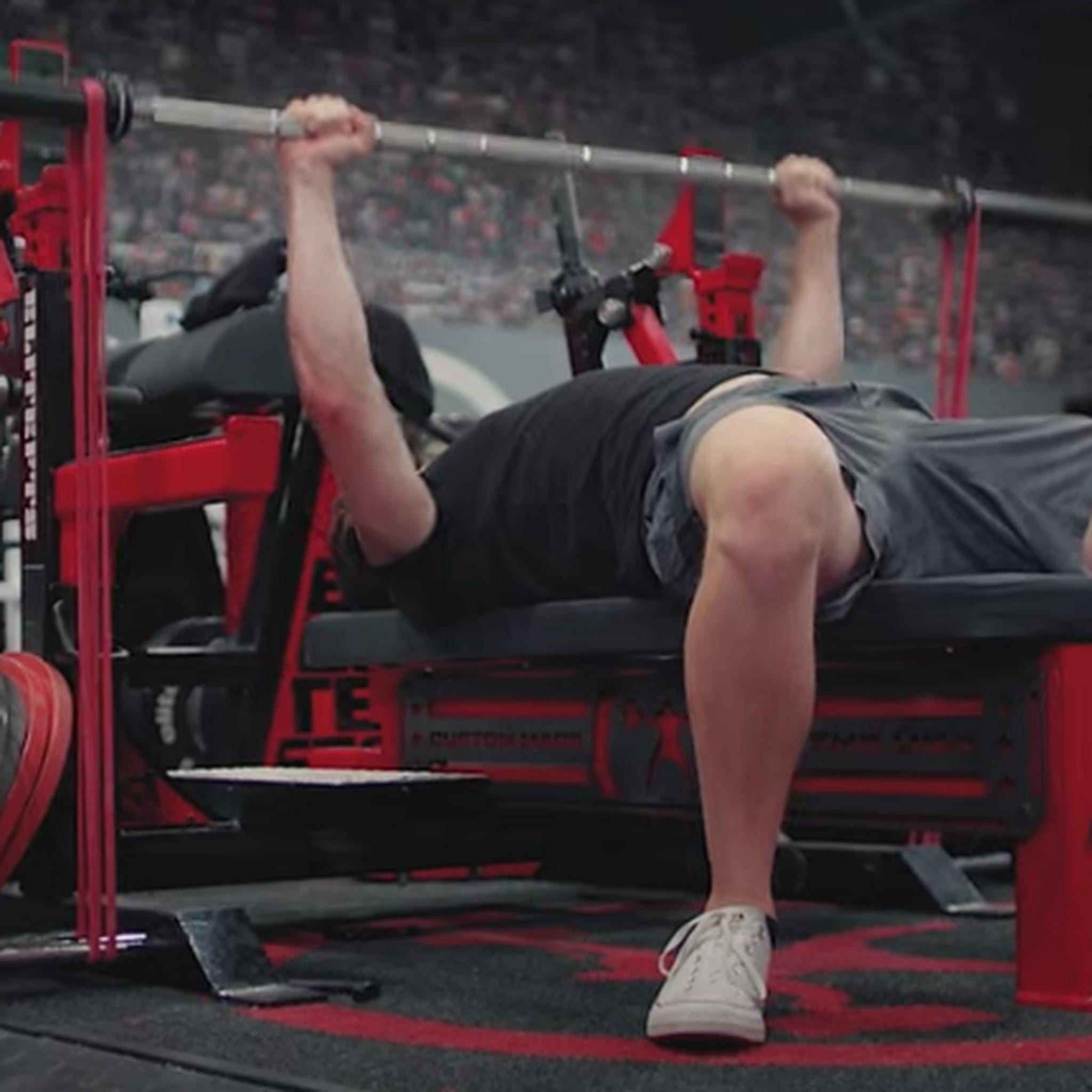
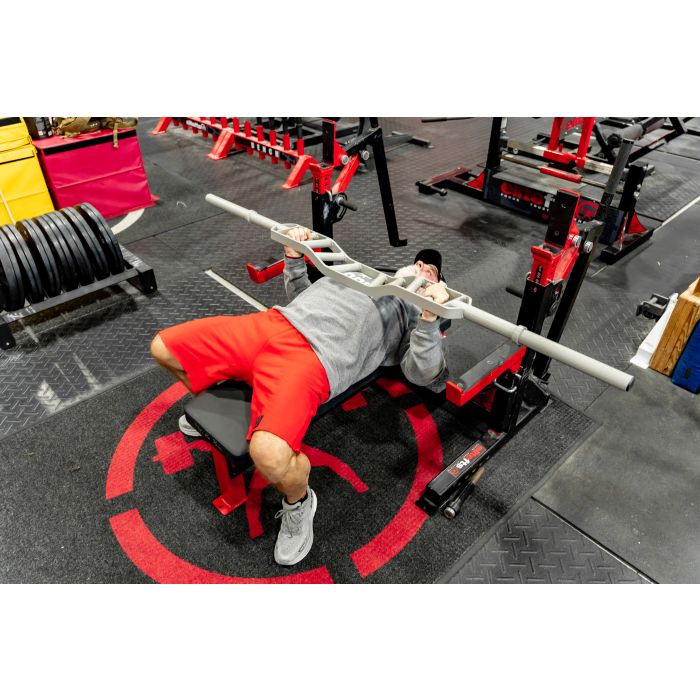
The bench press is not a chest exercise. It’s a total-body lift, and anyone who tells you otherwise is weak. To move serious weight, every muscle from your feet to your hands must be locked in. This begins with a fundamental mental shift. Forget pushing the bar. That's for beginners. You are driving your body through the fucking bench. The bar only moves because you're trying to leave a crater in the pad behind you.
To experience this, use the following drill from JM Blakeley: lie on the bench, place your feet on the pad, and drive your hips as high as possible. Feel that crushing pressure on your upper back and traps? That is the sensation you must recreate with your feet on the floor. When you’re loose, the bar shakes, your body squirms, and you leak force everywhere. Get tight, or stay weak.
The Setup: Building Your Launchpad
An elite press is born from an elite setup. Every step is a deliberate act of war against the weight. Do it right, every single time.
-
Set Your J-Hooks: Place the J-hooks at the absolute minimum height you can clear. Set them too high, and you’re forced to press the bar up and out of the rack. That one move flares your shoulders and instantly destroys all the tightness you just built. Your lift is over before it began. You must pull the bar out horizontally. This keeps your lats engaged and your upper back fused to the bench.
-
Create the Arch: Get your head completely off the bench to start. Dig your toes into the floor and set your feet. Grab the bar with your competition grip. Now, walk your body up the bench until your weight is evenly distributed across your upper traps. This locks you into the pad.
- Foot Position and Leg Drive: Your feet are not just resting on the floor. Drive your heels down and back as if you’re trying to push them through the concrete. Even if they don’t touch, the intent transfers your body’s tension directly onto your traps, creating an immovable platform for the press. This leg tension must be relentless from the moment you un-rack the bar until you rack it again.
Executing the Lift: Bar Path and Biomechanics
A perfect setup means nothing if your execution is garbage. Bar path and alignment are everything.
- First, your wrists and elbows must stay in a straight, vertical line under the bar at all times. This is non-negotiable. If the bar drifts behind your elbow, you’re doing a weak-ass tricep extension. If it drifts in front, you’re doing a front raise. Stack your joints and keep your power directly under the weight.
- During the eccentric (lowering) phase, you are in command. Actively pull the bar down. Tuck your elbows and guide the weight to the optimal point on your chest—the single spot that lets you generate maximum torque. Do not just let it drop.
- The concentric (pressing) phase is an explosion. The drive begins by trying to push yourself through the bench. This creates the violent, stable base that allows you to execute the following command: drive the bar back toward the rack and your face, not straight up. This move engages your lats as the primary movers, keeping your elbows under the bar and maintaining an efficient path. As the bar moves past the sticking point, your elbows will naturally flare. Keep driving and think "push the elbows together" until you achieve a violent lockout.
Get your phone out. Take video of your lifts from the side and analyze your bar path. Advanced lifters have a clear separation between their downward and upward paths. Yours should too. Fix it.
Smart Programming: Building Raw Strength on a Solid Base
Once your technique is established, programming becomes the driving force behind your progress. This is the long-term, strategic application of training stress. The principles that build an elite bench aren’t complex, but they demand absolute discipline. This is how you force adaptation and drive your numbers into new territory.
Core Programming Principles for Progress
These are the rules. Follow them, and you will get stronger.
-
Specificity is King: The 70% Rule.
- You don't get a big bench by doing flyes. At least 70% of your total bench press volume must be spent practicing the competition-style bench press, executed with the exact same technique you’d use to hit a new max.
- You don't get a big bench by doing flyes. At least 70% of your total bench press volume must be spent practicing the competition-style bench press, executed with the exact same technique you’d use to hit a new max.
-
Frequency and Volume: The Stimulus for Growth
- To get strong, you have to bench. Hit the lift two to three times per week.
- Cycle your volume to manage recovery and smash through plateaus. A simple, brutal starting point is:
- High Volume Week: 50 total lifts
- Medium Volume Week: 30-40 total lifts
-
Low Volume Week: 10-30 total lifts
-
Assistance Work: The 80/20 Rule
- Eighty percent of your time is dedicated to the bench press. The other 20% is spent building the armor that supports it: rear delts, lats, rhomboids, rotator cuffs, lower traps, and shoulders.
- Choose your tools intelligently. If you have long arms, close grip, and board presses are your new best friends. If your form is unstable, build raw power with incline presses. Identify your weakness and attack it without mercy.
Goal Setting and Strategic Overload
Progress demands a plan of attack. You don’t wander into a 405 bench; you strategically assault it.
- First, work backward from your target. Want to press 290? Then you first need to be able to hit 275 for a double, and 260 for a triple. Map out these milestones. This creates your roadmap to the big weights.
- Next, deploy strategic overload. Maxing out every week is a one-way ticket to snap city. But planned, short-term periods of going heavy are essential for breaking through. One week out of every three, push the intensity with AMRAP (As Many Reps As Possible) sets or heavy pyramid sets. This overload is a weapon to be used for a finite time, only after you’ve built a solid base with higher volume.
Two Proven Templates to Reach 405 Pounds
Theory is for the classroom. The weight room is for application. The following programs are battle-tested and proven to pack pounds onto any lifter's bench press. Below are two distinct but equally brutal methods for forging a four-plate bench.

Program A: The 5-Week Linear Cycle
This template is adapted from the build-ups of the legendary Ed Coan. The main bench press workout is performed once per week, following a simple progression of decreasing reps and increasing weight.
|
Week |
Sets |
Reps |
Percentage of 1RM |
|
1 |
3 |
10 |
75% |
|
2 |
3 |
8 |
78% |
|
3 |
3 |
6 |
83.5% |
|
4 |
4 |
4 |
88% |
|
5 |
3 |
3 |
90% |
For assistance work, add a second pressing day. On this day, follow the Sets x Reps structure for an incline bench or shoulder press, but select a weight that is challenging for that specific lift—do not use the percentages from your competition bench max. Follow this with 3-4 back exercises (such as rows or pull-downs) for 3 sets of 15 repetitions.
Program B: The Cast Iron Pressing Template
This is a more intensive two-day-per-week meathead method. Perform Day 2 three days after Day 1.
-
Day 1 Workout:
- Strict Press: Base Set / Heavy Set / Optional PB Attempt / Down Set
- Close Grip Press: Build up in fives to PB Attempt Set
- DB Shoulder Press: 2 Heavy Rep Sets (8-12 rep range)
- Bodybuilding: Triceps Work
-
Day 2 Workout (Three Days Later):
- Bench Press: Base Set / Heavy Set / Down Set / Pump Set
- Incline Barbell or Dumbbell: 2 Heavy Rep Sets (8-12 rep range)
- Bodybuilding: Chest Work
-
Key Definitions:
-
Base Set: A starting weight you can hit for a tough 6-7 reps. The goal is to add reps each week until you can perform 9-10.
-
Heavy Set: Base Set weight +45 lbs (bench) or +20 lbs (strict press) for 1-3 reps.
-
Down Set: Base Set weight -45 lbs (bench) or -22 lbs (strict press) for 10+ reps.
-
Pump Set: Down Set weight -22 to 44 lbs, performed until failure.
-
Base Set: A starting weight you can hit for a tough 6-7 reps. The goal is to add reps each week until you can perform 9-10.
- Progression and Deload: When your Base Set for an exercise reaches 9-10 reps, add 5 kilograms (11 lbs) to all subsequent sets in the next session. Run this program for three weeks on, one week off. The "off" week is for a max attempt or total rest. Do not perform any volume work.
Stop Searching, Start Mastering
The path to a 405-pound bench isn’t hidden in some secret exercise. It's forged in the relentless pursuit of technical perfection and backed by disciplined, intelligent programming. Everything you need is in this guide. The only variable now is you. Stop searching for shortcuts and start putting in the focused, brutal work on the fundamentals that matter. Master your technique, execute your program, and earn your seat at the four-plate table.