


How 47 Football Players Hit 20+ MPH in One Off-Season
Mark Uptegraff on joint work, connective tissue, and the systems behind the numbers.
Mark Uptegraff came out to the S5 Compound for Table Talk #439, and the number that opens this one is the kind that makes coaches sit up.
Nine guys on the team were running over 20 miles an hour coming into early offseason training last winter.
By the end of summer, forty-six of them were.
That's not the whole list either. Their fastest guy is over 23 miles an hour. Body weights went up across the board. The average offensive lineman weighed 275 to 295 last fall and now weighs 305 to 310. One offensive tackle went from 295 to 330 with better body composition and higher relative strength on both ends.
On the platform side, they went from around 24 or 25 guys classified as advanced lower body to 43 guys squatting over two times body weight. Ten guys over three times body weight. Thirteen guys over 600 pounds.
And the part I care about most: grade two MCL injuries that normally cost a guy four to six weeks got him back in eleven days.
None of that came from one magic exercise. It came from systems. Here's what's actually in them.
Who Mark Is and Why It Matters
Mark walked on at North Carolina and played center for three years. He was 6'2", 285 in eighth grade, which sounds like an advantage until you get to college and find out you're the smallest offensive lineman in the room. His dad is 6'8" and played there too.
He medically retired, started interning with the strength staff in his senior year, and never left the profession. Ohio State internship. Two years as a GA at Virginia Tech. Director at Wittenberg. Boston College. Northern Illinois. Now running his own program at Fordham.
Something worth noting: his high school strength coach at Fort Union Military Academy, Brian Herlocker, was a Westside guy. Mark was doing conjugate work as a teenager. Herlocker still jokes with him that the players were his guinea pigs. Mark's response is that it all worked and they got bigger, stronger, and faster.
Seven or eight stops in eight years. That matters because whatever his philosophy is, it has to travel. It has to work at a Division III school with 650 athletes and a three-person staff, and at Boston College. The pillars can't change based on the letterhead.
The Skill Gap Nobody Certifies For
I've watched this profession for four decades. The biggest gap I see in strength and conditioning, especially in the public sector, isn't programming knowledge.
It's communication.
Every certification you take is 80 percent X's and O's. Some of them are 100 percent. And the X's and O's matter. But if you trace back the coaches who have been around for three decades, they are all good communicators. Every one of them. The ones who came in without those skills didn't last, and nobody ever coached them on it either.
Mark got the version of this lesson that sticks. He graduated from military school as a first lieutenant in charge of 83 or 84 cadets. In that world, you say it, and it happens, no questions. Then you're 22 years old on the floor at Ohio State with 17 to 22-year-olds who don't come from that background, and what you think is hard coaching lands as something else entirely.
"Your reality is other people's perception of you."
If you intend to come across one way and it isn't received that way, your intent doesn't matter.
The second line he picked up is one every coach should tape to a wall: feedback is important, timely feedback is more important. If you sit on a correction for a month, six months, or a year, you never give that person a chance to fix it. Say it in the moment.
I'd add one thing to how people receive criticism. Most take it as a verdict on who they are rather than on what they did. You perform two or three thousand actions in a day. Somebody pointing at one of them is not pointing at all of you. Mark's framing is the right one: worry when nobody is bothering to correct you. That's when they've stopped caring.
Explaining the Why
Mark's coaching philosophy is three words. Educate, empower, prepare.
The education part is where most coaches fumble. You're explaining the same thing to an 18-year-old rookie who knows nothing, a fourth-year starter, a position coach, and a head coach. Same content, different delivery.
At Fordham, he works for Joe Conlin, who played D-line at Pitt under Buddy Morris and still trains hard. Mark said that was the most training-competent head coach interview he's ever had, and he could get into the weeds because of it.
Everybody else gets the simple version. That's my rule too. Lead with the dumbed-down answer for everyone. The people who want more will ask for more. You almost never lose by starting simple, and you lose a room fast by going over their heads.
Train All Athletic Qualities All the Time
Here's the piece that explains those return-to-play numbers.
Mark pulled a quote from John Quint on a Westside Barbell podcast that reframed how he programs. Paraphrasing the idea: the profession has focused heavily on nervous system function and muscular training at the expense of connective tissue support and the development of good joints and articulations.
Now look at what actually takes athletes off the field.
Sprained ankles. Achilles. Quad and patellar tendon. ACL, MCL, PCL, LCL. Hip labrums. Bulging and herniated discs. Shoulder labrums. AC joint sprains. UCLs.
Joints and connective tissue. Almost all of it.
So if that's where they break, why is that work only showing up in the return-to-play protocol after somebody's already hurt? Mark's answer is to put it on the front end, proactively, twice a week, every week.
The framing he uses is that you train all athletic qualities all the time. Absolute strength, relative strength, speed strength, reactive strength, energy system development, linear speed, change of direction, mobility, joint function, connective tissue. Nothing gets removed. What changes is the emphasis based on where the athlete is in his development.
What the Warm-Up Actually Looks Like
Mark spends 15 to 25 minutes warming athletes up before he loads them. He's had coaches tell him that's too long. It isn't a warm-up. Calling it one undersells it.
Step one is mobilizing the joint. Standing hip CARs, seated 90/90, bear sit, frog, and single leg frog, working hip extension, hip flexion, internal and external rotation. The goal is to improve joint function by increasing joint capsular space.
Step two is loading the tissue. Long-duration low-intensity isometrics, short-duration high-intensity isometrics, and iso ramping at different joint angles, intensities, and durations. Progressive and regressive angular isometric loading, or PAILs and RAILs, are out of the FRC coursework.
The number to know: you need a minimum of 40 seconds of time under tension to elicit tendon morphology. That's the floor, not the target.
Practically, it looks like single-leg hip lifts, glute marches, and glute ham walkouts at different joint angles. The walkouts are deliberately trained at the end range because that's where hamstrings tear. Guys pull them when they're overreaching and overextended, so that's the position that needs strength.
For the groin and adductors, they'll do frog and single-leg frog for reps, then go straight to iso ramping at 25, 50, 75, and 100 percent for ten seconds each to hit the 40-second minimum, then into single-leg frog. That's training the adductors and the MCL in one sequence. The foot, ankle, and calf complex gets the same treatment. Bilateral and unilateral calf iso holds, straight leg, bent knee, knee over toe, loaded and unloaded.
Once the athletes learn the sequence, that 25 minutes compresses to 10 or 15. And if time is still your objection, there's an easy fix. Three of those pieces are upper-body dominant. Run them in the rest periods between squat sets. With three or four guys per rack, you've got time sitting idle.
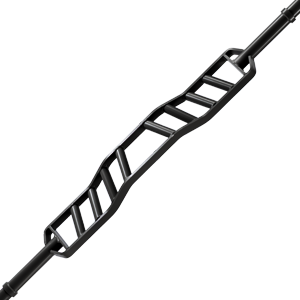
Mark also mentioned getting SS Yoke Bars at Fordham, which opened up Hatfield split squats so they could load heavy unilateral work. That matters for field and court athletes, because for at least a fraction of a second, they're on one leg almost every play. If you want the full breakdown of what that bar can do beyond being a straight bar substitute, we covered it in How to Use the elitefts, SS Yoke Bar.
The Blanket Program Problem
Mark could write a single program for the entire roster. Same exercises, same volume, same intensities, same conditioning. Some guys would benefit. A lot wouldn't.
Here's the part I'd push harder on. If a one-size program serves 50 percent of your team, that 50 percent is the average. It isn't catching your best guys, and it isn't catching your worst. So who exactly is the strength and conditioning program there to serve? You want to bring the bottom up and push the top higher. A blanket program does neither.
So they individualize on absolute strength, relative strength, years in the program, training age, position group, playing time, injury history, individual weaknesses, and body composition.
What They Monitor
Mark doesn't like the word test. He uses a monitor, because this isn't a twice-a-year event. It's tracked week to week, all year.
- Body composition, body weight, anthropometrics
- Vert, broad, pro agility, 10-yard splits, flying 10 (no 40s, personal preference)
- Max effort squat and bench
- Relative strength by position group
- Nordbord for hamstring max force output
- Force plates
- Catapult GPS
- Hip internal rotation assessments
That last one connects directly to injury reduction. Get the hamstrings very strong from a hip-dominant standpoint to protect the knee, improve hip internal rotation, and you mitigate a lot of lower extremity knee problems. The assessment tells you whether it's actually improving, rather than you hoping it is.
The Advancement Standard
Guys move from non-advanced to advanced when they hit relative strength requirements specific to their position group, and after a year in the program. That year isn't arbitrary. It's there to make sure they can perform the main movements well before you turn up the dial.
THE MINIMUMS
Squat: 2 to 2.15x body weight minimum. Plenty of guys sit at 2.5, 2.8, over 3.
Press: Skill 1.5x body weight. Semis and big skill 1.3 to 1.35x. Bigs 1.15 to 1.25x.
For the developmental guys, the main squat variations are front, back, and box. The box squat coaching is straight out of the playbook most of you already know: hip dominant, send the hips back, vertical shins, knees stacked over ankles, control it down, pause, then move it off the box with intent.
Once a guy clears the strength standard, the emphasis shifts to speed strength and power. The strength work doesn't leave. It just stops being the priority.
He was clear about the distinction, and it's worth repeating for the lifters reading this: the goal in powerlifting is to lift as much as possible. The goal here is a guy moving dynamically through space. Strength is a means.
Intent Is the Whole Thing
Intent is a word that gets thrown around without a definition. Mark's is two-part.
First, being cognizant of how to perform the movement correctly. Form and technique come before anything. Second, effort. His words to his guys: it doesn't matter if there's 135 or 600 on the bar, your job is to get under it and move it with violent intent.
He ties it to the field. When you get under that bar, it's fourth and one. Your teammates are counting on you to get that yard. Can they count on you? He says the guys flipped a switch, and this past offseason they moved weight he didn't think was in them.
Here's something I raised with him that I think matters. On turf, when an athlete drops intent, you see it from 50 yards away. The stride length goes, the whole thing falls apart; it sticks out like a sore thumb.
In the weight room, intent hides.
On big lifts, you'll catch form breakdown. But on a lot of accessory work, the movement is designed so there's barely any form to break down. A guy can go through the motions and look identical to a guy who's fully locked in. Somebody with 20 years under the bar can spot it. An 18-year-old freshman can't, and neither can most people watching him.
Which is why intent has to be defined and ingrained before the set, not corrected during it.
Coaching During vs. Coaching After
At Fordham, they run three or four guys per rack. One lifting, one spotting, and the others watching for form and giving feedback. With 50 to 55 guys training at once and three staff, he needs the extra eyes.
The feedback from teammates comes after the set. During the set, their coaching effort and strain.
The question I put to him: Doesn't that mirror the sport better? On game day, nobody's talking you through the play. You have to know it before the snap. And there's a second effect. If a guy gets told after set one that something was off and he has to fix it on set two, the only way he fixes it is by focusing. You just raised his intent without saying the word.
Obvious exception. If somebody's about to get hurt, you say it now.
The other thing Mark does well: if one guy's making a mistake, coach that guy. If he's walking the floor and seeing the same mistake from a bunch of guys, he kills the music, brings everybody up, demos it, and fixes it as a team.
What Changed With Injuries
Grade one is minor. Grade two is significant. Grade three is a complete rupture. The standard return-to-play timeline for a grade two connective tissue injury is four to six weeks. In season, that's four to six games. A third to half a season.
Fordham got D-linemen back in as little as 11 days with grade two MCLs.
Mark's read on why: they've been proactively exposing that tissue to stress all year, in warm-ups and in training. The tissue was already stronger and more receptive to healing. They also built the same joint work and connective tissue