
Master the X-Frame
How the Posterior Oblique Sling, Diagonal Tension, and the Bird Dog Row Build True Athletic Stability
elitefts | Training | Performance
In the world of strength training, many beginners focus solely on how much weight they can move from point A to point B.
True athletic performance and postural integrity rely on something deeper: a real understanding of how the body stabilizes itself under load.
To move like an athlete, you must first master the mechanics of the X-Frame.
When we think of stability, we often imagine vertical pillars or horizontal beams. But human movement is more complex. The body does not stabilize itself in simple straight lines. It relies on diagonal tension to maintain its structure.
To visualize this, consider how you might protect a fragile object.
The Pane of Glass Analogy. If you wanted to reinforce a large pane of glass to prevent it from shattering or vibrating under external pressure, you wouldn't put a single support beam straight down the middle. To truly secure the structure, you would place your reinforcements in an "X" pattern from corner to corner.
Without this "X," your spine is essentially that unsupported pane of glass: vulnerable to injury or instability when subjected to the high-torque forces of heavy lifting or contact sports.
While the "X" provides the blueprint for bracing, we must examine the specific tissues that generate this tension. This internal diagonal system is known as the Posterior Oblique Sling.
The Posterior Oblique Sling (POS) is more than jargon. It is a critical biomechanical chain that facilitates the contralateral connection between your upper and lower body.
The bridge of this "X" is the thoracolumbar fascia: a dense web of connective tissue that allows force to travel from one side of the back to the opposite hip.
The "X" is formed by the following contralateral pairs:
- Left Gluteus Maximus and Right Latissimus Dorsi
- Right Gluteus Maximus and Left Latissimus Dorsi
When these muscles fire together, they compress the sacroiliac joint and lock in the torso. Training these diagonal lines teaches your core to act as a functional bridge, ensuring postural integrity even when pulling heavy weights or resisting an opponent.

Not all rows serve the same purpose. Depending on your setup, a row can focus on building raw muscle size or developing elite-level coordination and postural strength.
| Row Variation | Primary Focus | Key Benefit |
|---|---|---|
| Traditional One-Arm Row | Maximal Load | Highest weight capacity. Focus on back thickness and strategic lengthening of the lat. |
| Fisherman's Row | Postural Coordination | Upper back and rear delt dominant. Mentally visualize leaning over the edge of a boat to pull in a heavy net. Requires high bracing to avoid being pulled overboard. |
| Bird Dog Row | Postural Stability | Lat dominant. The ultimate test of the X-Frame. Uses a minimal base of support to force total-body coordination. |
While the Fisherman's Row is excellent for grapplers who need to pull from a flared, braced position, it still provides a relatively stable base.
To truly challenge the POS, we move to the Bird Dog Row: the gold standard for teaching X-Frame mechanics.
"To move like an athlete, you must train like one. The Bird Dog Row removes your safety net and forces the sling to do all the work."
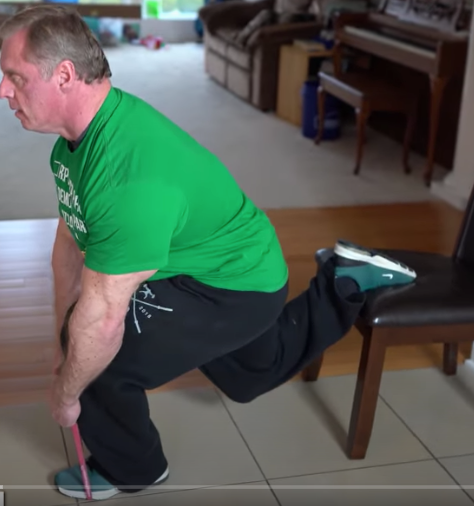
The Bird Dog Row forces the sling to do all the work by removing two points of contact from the ground. This variation demands trilateral length: tension through the head, the neck, and the heel.
- Find Your Base. Set up on a bench with your hand or fist directly below your shoulder and your opposite knee directly below your hip. Using a fist can provide a more stable, neutral wrist for those with joint discomfort.
- Extend the X. Extend the opposite leg straight back. If you are rowing with your right hand, your left glute must be engaged to stabilize the extended left leg.
- Create Length. Think long spine, long neck, long leg. Push the crown of your head away from the heel of your extended leg to create a rigid, neutral axis.
- The Row. Pull the weight toward your hip in a lat-dominant arc.
Pro-Tip: Keep the rowing path tucked and narrow. When the elbow flares out, it creates a wide lever arm and massive rotational torque. This shift in the center of mass will shatter your X-Frame stability, making it nearly impossible to stay balanced on the bench. Stay narrow to stay stable.
The Bird Dog Row is fundamentally an anti-rotation exercise. The primary challenge isn't just pulling the weight. It's preventing the load from pulling you out of position.
In a kinesiologically sound row, the defining success metric is the return to neutral.
- Strategic Lengthening: A controlled movement where you allow the shoulder blade (scapula) to move across the rib cage at the bottom of the rep to maximize lat tension.
- Excessive Cheating: Using body English or explosive rotation to fling the weight up. This twist at the top overshoots the neutral position and bleeds tension out of the back muscles.
In the Bird Dog Row, your shoulders should remain level with the floor at all times. If you rotate to move the weight, you have lost the "X" and the postural strength it provides.
This focus on purpose over weight is what separates an athlete from a mere lifter.
If your only goal is to build the largest back possible, traditional chest-supported rows are superior because they allow for maximal mechanical tension.
But for athletes, martial artists, or anyone focused on movement quality, the Bird Dog Row is the clear winner. It forces you to prioritize integrity over ego.
Mastering the X-Frame requires adherence to the 3 Pillars of the X-Frame Athlete:
The ability to maintain trilateral length (head, neck, and heel) under the stress of a load.
Mastering the communication between the latissimus dorsi and the contralateral glute via the thoracolumbar fascia.
Prioritizing anti-rotation and return to neutral over the total amount of weight on the bar.
By mastering these diagonal lines, you don't just get stronger. You become more stable in the most functional sense, transforming how your body performs in every other movement, from sprinting on the field to grappling on the mats.