
TL;DR
- Choose the cambered bar for a specific training need.
- Use additional pressing range only as far as you can control it.
- Explore rows, triceps extensions, and overhead presses for added range or clearance.
- Reverse the orientation for restricted-range soft-touch benching, and track each setup separately.
When somebody asks what a specialty bar is good for, the first thing I want to know is what they are trying to do with it. Where are they weak? What movement are they trying to train? What is getting in the way?
Those questions matter with the four-inch cambered bar because people tend to see the bend, think about getting a deeper stretch on the bench press, and stop there. That is one application. There are also rows, triceps extensions, overhead presses, and even a way to turn the bar around for restricted-range soft-touch benching.
The useful part is understanding what the camber changes in each movement. Then you can decide whether that change gives you something you need.
Start With the Problem
Let's use the bench press first. You miss a weight near your chest, so you decide your chest is weak. You add more chest work. A few weeks later, you miss in the same place.
Before adding another exercise, look at how you got there.
In my Bench Manual, I addressed several reasons a lifter can get stuck near the bottom: lack of speed, losing tightness, weak lats, poor pressing technique, and simply putting too much weight on the bar. Those require different answers. If your setup falls apart as you lower the weight, you need to address that. If you picked a weight you had no chance of lifting, calling it a sticking point does not tell you much.
A cambered press gives you another way to train the bottom portion of the movement. It also asks you to maintain your position through the range you choose. That can be useful, provided you have identified a reason to do it.
Watch the lift. Look at the setup, the descent, and what changes when the press gets hard. Choose the exercise after you understand the problem.
What the Camber Changes

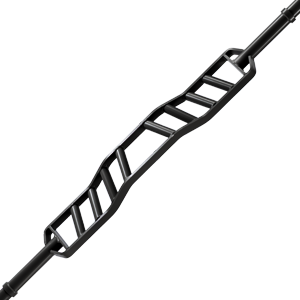
With a straight bar, your torso limits how far the bar can descend on a bench press. The four-inch offset in the middle of this bar creates clearance, allowing your hands to travel lower.
That gives you access to additional range at the bottom. You have to control the weight there and press from that position. The extra travel can also extend the work within a repetition, depending on how you perform it.
The same clearance can be useful on rows. On extensions and overhead presses, keeping the center of the bar away from your face changes how the movement feels. Reverse its orientation for a soft-touch bench, and you can use the offset to restrict the range instead.
That last point gets overlooked. The camber gives you options. You still have to choose the orientation, range, and exercise that make sense for the work you are doing.
Decide How Deep to Go
Four inches of camber does not mean you need four additional inches of pressing depth under a heavy load.
In the Bench Manual, I made a distinction between taking the cambered bar all the way down with very light weight and using it for heavy pressing. For heavy work, my recommendation was to go only about half an inch below the position you would reach with a regular bar. Boards were used to control that depth.
The point was to train below the normal stopping position without forcing all the available range. I also cautioned against bringing heavy weight all the way to the chest because of the additional shoulder rotation involved.
That context matters when you see somebody using this bar. A light set through a larger range and a heavy press to a controlled depth are different applications. Copying the depth without knowing the load and purpose misses the reasoning behind the exercise.
Start by establishing a position you can control. Keep the descent consistent. If you use boards, make the setup repeatable so you know where the movement ends. Excessive strain in the pecs or shoulders is a reason to change what you are doing, not a reason to force the bar lower.
This applies to comparing your sets, too. A heavier set performed through less range does not tell you that you got stronger through the original range. Write down the setup along with the weight.

Give It a Job in the Program
The cambered bar can be used for a main pressing movement or for supplemental work. Decide which job it is doing before you start loading it.
For an experienced lifter using a max-effort approach, a controlled-depth cambered press can be one of the pressing variations in the rotation. The general framework I described in "Pressing Power" was one main max-effort movement for the bench, once per week, building through warm-up sets of three to five toward a one- or three-rep maximum on the selected movement.
That framework does not erase the depth restrictions discussed above. It also does not mean your first session with an unfamiliar bar should become a max-out session. You need to understand the movement and establish the setup before a record means anything.
For supplemental work, the question is what you need to build after the main movement. The Bench Manual includes a general framework of two to four working sets of three to eight reps for supplemental triceps presses and extensions. That provides a programming reference, not a requirement to force every cambered-bar exercise into the same prescription.
You can also use the bar for repetition work when the purpose is to accumulate useful muscular work rather than establish a maximum. Keep that purpose clear. If you are trying to train your chest through a controlled range, the set should still resemble that exercise as you fatigue.
You do not need to use the bar for every pressing slot because it is sitting in the rack. Choose the application that addresses the weakness, account for the work you already do, and evaluate the result.
Barbell Rows: Use the Clearance
One of the other uses I want people to consider is barbell rows. The camber can give you a better range of motion because the center of the bar has clearance around your torso.
With a straight bar, contact with your body can end the movement before you have used the range you want. The cambered bar changes that relationship. It gives you room to continue the row rather than having the straight shaft determine the stopping point.
You still need to perform a row. If getting the bar farther back requires changing your torso position on every rep, you have changed more than the range of the pull. Keep the setup consistent enough to know what you are training.
Try it and pay attention to the movement. Some lifters will find the additional clearance useful. Others will prefer another rowing variation. The reason to keep it is that it helps you do the work you intended.
Triceps Extensions: Clearance and Wrist Position
I find this a much more comfortable bar for triceps extensions. Part of that is the clearance. The offset keeps the bar away from your face, which changes how you can perform the movement compared with a straight bar.
The other part is how your hand sits against the camber. On extensions, allowing the thumb to ride inside the camber can put the wrist in a more favorable position and take some stress off the elbows. That is a detail worth paying attention to when evaluating the bar for triceps work.
The exact hand position matters, so don't turn that description into permission to use an insecure grip. Establish a secure hold and a controlled movement. The thumb-position point here concerns extensions; it is not an instruction to use a thumbless grip on overhead presses.
Comfort will differ between lifters. Find the position that lets you train the movement without forcing your wrists and elbows into a position they do not tolerate. The camber gives you another option to evaluate.
Overhead Presses: Get the Bar Away From Your Face
I also find this bar more comfortable for overhead presses because the center of the bar is away from the face. Anyone who has had to work around the path of a straight bar can understand why that clearance may be useful.
Think about the path of the bar and where the camber sits before loading it. The benefit being discussed is clearance. You still need control of the bar and a consistent press.
It gives you another pressing option when that shape suits the movement better. It does not make every overhead variation appropriate for every lifter or remove the need to pay attention to how the exercise feels.
Turn It Around for Soft-Touch Benches
Here is an application a lot of people miss: using the bar in the opposite direction for soft-touch bench presses with a restricted range of motion.
Most of the discussion around this bar focuses on going deeper. Reverse the orientation and you can use the camber to shorten the movement instead. That makes the same bar useful for another pressing application without pretending that every set needs the largest possible range.
The important pieces are the orientation, the selected touch position, and the soft touch itself. Establish those with light weight before building the load. You want a controlled, repeatable bottom position rather than a different stopping point on every rep.
Treat it as its own variation in your training log. Record the setup so a later set can be compared with the same movement. A restricted-range soft-touch press and an additional-range cambered press serve different purposes, even though you are holding the same bar.
What Should You Expect From It?
The reviews on the elitefts Black 4-inch Cambered Bar include comments about the knurling, finish, and having another tool for chest training. Those are useful observations when considering a bar. They do not tell you how much your bench will improve.
Your training has to answer that question. Record the grip, orientation, depth or board setup, load, and repetitions. Note whether you maintained the position you intended. For extensions and overhead presses, pay attention to whether the clearance actually makes the movement more comfortable for you.
Then go back to the reason you selected it. If you used it to address the bottom of your bench, look at what happens when you return to your regular bench. If you chose it for rows or extensions, evaluate whether it lets you train those movements more effectively and consistently.
Getting better at an exercise gives you information. You still have to decide whether that improvement is helping the larger goal. Keep the useful work, adjust what needs changing, and don't confuse using more equipment with making more progress.
Make the Bar Earn Its Place
The four-inch cambered bar gives you several ways to change upper-body training: additional range on presses and rows, clearance on extensions and overhead presses, and restricted-range soft-touch benching when you reverse it.
Start with the movement you need to improve. Choose the application, establish the setup, and track what happens. That is how you find out whether this bar belongs in your program.
elitefts Black 4-inch Cambered Bar
Explore the bar and choose the application that fits your training.
BUY NOWLive, Learn, Pass On.