

I Built This Because Nothing Else Worked
The Origin of the elitefts 3-Loop Tricep Strap and Why It Has Never Left My Cable Machine
I've been around long enough to know when a piece of equipment is failing me.
And for years, every tricep strap on the market was failing me.
Not because they were cheap. Not because they were poorly made. But because none of them gave me the full range of motion I needed to actually train my triceps the way they need to be trained.
I've been competing in powerlifting long enough to understand what the tricep actually does in this sport. It locks out the bench. It finishes the press. It is the difference between a good training cycle and a great one, and it is the difference between making a lift on the platform and watching it get called down.
Every pound you leave on the platform at a meet can often be traced back to a tricep that wasn't strong enough, wasn't developed enough, or wasn't trained with enough intention during the weeks and months leading up to that moment. I have seen it happen too many times to count. Including to myself.
So accessory work for the tricep was never an afterthought in my programming. It was a priority. It got real time, real weight, and real focus. Heavy skull crushers, JM presses, band pushdowns, cable work in all directions. If it built the tricep, it had a place in the program.
Which made it even more frustrating that the tools available for cable pushdown work were all falling short in the exact same way, and nobody seemed to be doing anything about it.

Pick up any standard rope attachment or single-loop strap and do a set of pushdowns.
Pay attention to where the movement actually begins and where it ends. Really pay attention.
You get a partial stretch at the top. You get a reasonable contraction at the bottom if you cue it right. But you are never fully loaded in both positions. You are always compromising one end of the range to get anything out of the other. The rope that gives you a decent spread at the bottom chokes off the stretch at the top. The single-loop strap lets you start in a reasonable position, but it runs out of travel before you reach full lockout.
For a long time I accepted that as the limitation of cable pushdown work. Load the movement. Get the reps in. Move on. The bar would tell me whether my triceps were strong enough; if they weren't, I'd add more volume and more weight and see what happened.
But the more I paid attention to how my triceps were actually responding, and the more I thought carefully about what was happening at both ends of the movement, the clearer it became that I was leaving real development on the table. Not just a little. A significant amount.
"The stretch position builds the muscle. The contraction position builds the strength. I wasn't getting either end. Not completely."Dave Tate
The stretch position builds the muscle. That deep, loaded position at the top of the pushdown, where the long head of the tricep is fully elongated under tension, is where hypertrophy happens. That's where you're adding size to a muscle that already has a lot of demand placed on it from your main lifts. And every strap I was using was cutting that short. I was never getting the full stretch. I was starting the movement a few degrees early every single set.
The contraction position builds strength. Full lockout. Full extension. The same position you need on the platform when the bar is two inches from the top, and everything depends on whether your tricep can fire hard enough to finish the job. And again, every strap I owned was giving me something less than full. The movement was ending before it was actually over.
I wasn't getting either end. Not completely. Multiply that across thousands of sets over years of training and you are talking about a meaningful amount of development that never happened because the tool between my hands and the cable stack was limiting what the movement could deliver.
That realization changed things. I stopped accepting the limitation and started thinking about how to solve it.
The solution wasn't complicated once I clearly identified the problem.
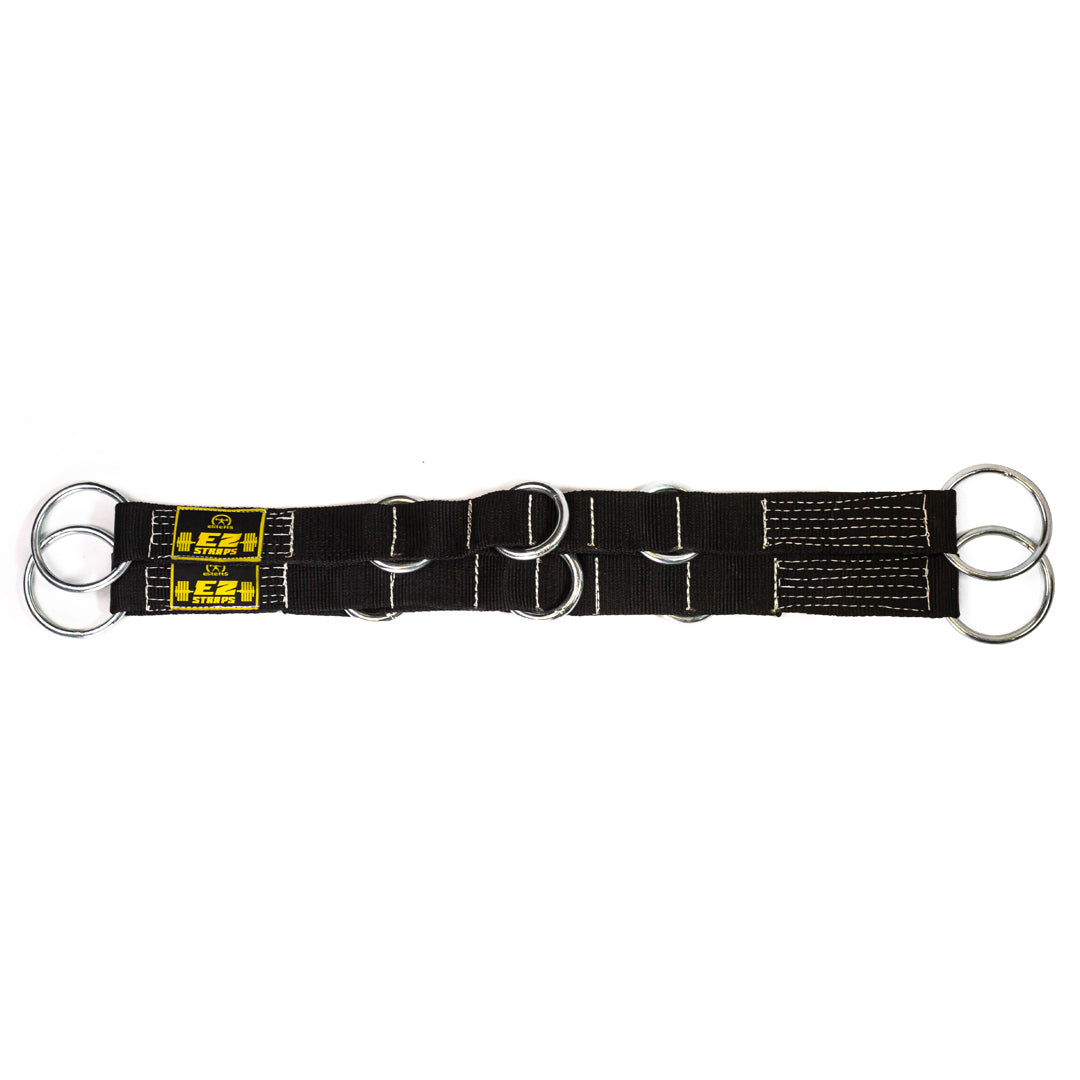
I didn't need a new attachment category. I didn't need something that looked different or was marketed differently. I needed a strap with more than one position. Not different attachments for different parts of the movement. One strap. Multiple loops. Each one is engineered to do a specific job at a specific point in the range of motion.
The design process started in 2013. What I was after was an attachment that would allow the fullest possible stretch at the top and the fullest possible contraction at the bottom, without sacrificing one to get the other. The three-loop structure was the answer.
Short loops for the stretch. When you grip the short loops at the start of a pushdown, the strap puts your hands in a position that allows the tricep to fully elongate under load. You feel it immediately the first time you use it. That deep pull at the top of the movement that you have never quite reached with a rope or a standard strap, because the standard strap would never let you get there. It is not as comfortable as a half-range rep. It is the kind of uncomfortable that tells you the muscle is actually working the way it is supposed to work. That is what a loaded stretch feels like. That is the feeling you should be chasing.
Long loops for the contraction. As you drive through the movement and reach lockout, the long loops allow for a full, hard contraction that you can hold and feel deliberately. Not a rushed finish where you bounce out of the bottom and reset. A locked extension where the tricep is doing everything it should be doing, and you know it because you can feel every fiber of it working. That is the position that translates to the platform. That is the position that finishes heavy benches.

How to Use It for Tricep Pushdowns
Start with the short loops for your first few sets to establish the stretch position. Feel where your range of motion actually begins when the strap is set up correctly. Then move to the long loops and focus on the lockout. Full extension. Hold it. You can also work through both loop positions within a single set once you're familiar with the strap.
For the first time, I had an attachment that covered both ends of the movement completely. The difference in how my triceps responded was not subtle. It was immediate and significant. Sets that I had been doing for years started feeling different because the range was finally correct.
The interior padding was part of the original design as well, and it matters more than it sounds. Under heavy loads and high volume, a strap that digs into your hands pulls your attention out of the muscle and into your grip. The padding keeps your hands locked in comfortably through sets that would have been uncomfortable on anything else. No slipping. No skin irritation. No distraction from what you are supposed to be training.
I had been training for decades at that point. I knew the difference between equipment that worked and equipment that felt like it worked. This one worked.
I didn't design this strap for ab work. That came later, and it might be the thing I talk about most when someone asks me about this strap now.
Here is the problem with most cable ab work that nobody talks about, honestly.
Your grip gives out before your abs do.
You are doing kneeling cable crunches or standing pulldowns, and by the third or fourth set the limiting factor is not your core. It is your hands. You are white-knuckling a rope attachment, your wrists are bent at an angle that does not feel right, your forearms are fatigued from the previous exercises, and the load that is supposed to be driving into your abs is being dispersed across half your upper body just so you can hold on.
Your abs are not failing. Your grip is failing. Those are two very different training problems, and conflating them means you are never actually training your abs as hard as you can train them.
I noticed that the short loops on the strap were the right size and shape to wrap around the wrists rather than grip with the hands. Once I figured out the positioning, the setup was straightforward.
- Wrap the short loops around your wrists, not your hands
- Lock your hands together under your chin and keep them there
- Your hands are now fixed in position, not gripping anything
- The cable load travels from the stack directly into your wrists and into the crunch
- Your abs are now the only limiting factor in the set
No grip fatigue. No wrist angle problems. No forearms are taking over the movement. Just your core, loaded and working the way ab work is supposed to work when the other variables are removed.
The difference in how hard I could push my ab training from that point was significant. Sets that had been cut short by grip were now ending because my abs were done. That is exactly what you want. That is the training stimulus you are looking for every time you attach something to a cable stack and try to work your core.
"When the strap removes grip from the equation, the abs finally get to do the work."Dave Tate

The guys training at the compound started using it the same way within a few weeks of seeing it. Then I started programming it for remote coaching clients. Same result across the board, from competitive powerlifters looking to shore up their core work to general strength athletes who had been frustrated with their ab training for years without knowing exactly why. When grip stops being the problem, the abs finally get addressed.
Kneeling cable crunches. Standing pulldowns. Rotational cable work with a fixed wrist position. All of it cleaner, harder, and more effective than anything I had done or coached before with a standard attachment.
Once the strap was in the gym and serious people started putting their hands on it, the applications kept expanding beyond what I had originally designed it for.
That is what happens when good equipment gets into a room full of people who pay close attention to how their training feels and are always looking for a better way to execute a movement.
Face pulls with this strap differ from those with a rope. The loop setup allows your hands to sit in a position that takes the wrists almost entirely out of the movement. The load goes where it should go: into the rear delts, the upper traps, the external rotators. For lifters dealing with shoulder issues, and that is most powerlifters at some point in their career, that wrist position change can be the difference between being able to train the movement pain-free and avoiding it entirely. I have had people tell me this strap fixed their face-pull technique when nothing else did. That is not the strap fixing anything. That is the strap finally allowing the correct mechanics to happen.
For rows, the loop options change what you're emphasizing without requiring you to swap attachments mid-session. Close and neutral through the short loops. Slightly wider through the long loops. Different pull angles, different parts of the back receiving the primary stimulus. You can run through several variations in a single cable session without touching any other equipment. That kind of efficiency matters when your training time is limited and you need to cover a lot of ground in a session.
Overhead tricep extensions. Pull-throughs. Cross-body work. Extensions from multiple cable positions. Every time someone at the compound grabbed this strap and tried it on a movement it was not originally designed for, they found something that worked better than what they had been using.
That was not by design. I built it to solve the pushdown problem. But good equipment has a way of revealing what else it can do once it is in the hands of serious people who are actually paying attention.
- Tricep pushdowns: short loops for stretch, long loops for contraction
- Overhead tricep extensions: full range without wrist interference
- Cross-body extensions: lock into a position and pull through cleanly
- Face pulls: wrists out of the equation, rear delts finally doing the work
- Cable rows: grip variation without swapping attachments
- Kneeling ab crunches: wrap wrists, lock hands under chin, load the core
- Standing ab pulldowns: same wrist wrap setup, standing variation
- Pull-throughs: consistent hand position through the entire movement
I get asked sometimes whether I still train the way I used to.
The honest answer is that the movements, weights, and goals have changed significantly over the years. My body has changed. What I need from training now is different from what I needed in my peak competitive years. I am not chasing meet totals at this point in my life. I am chasing longevity and function and continuing to do the work that keeps me healthy enough to stay in the gym and stay connected to this sport.
What has not changed is the standard I hold my equipment to. If something is not doing the job it is supposed to do, I stop using it. I do not keep things around out of loyalty or habit. The gym is not the place for sentimentality about gear. You use what works, and you replace what doesn't.
This strap is still the first thing I clip onto the cable machine. Not because I made it. Not because we sell it. Because nothing that has come out in the ten-plus years since has replaced what it does for both ends of the pushdown, for ab work with the wrist-lock setup, or for the other cable movements I use it on regularly.
Still In Rotation
Short loops on stretch work. Long loops for everything focused on contraction and lockout. Wrist wrap for kneeling and standing cable ab work. Face pulls, rows, and overhead extensions when nothing else on the rack makes sense. That is the current rotation, over a decade after I built the thing.
Athletes who have trained at the compound have taken one home when they left. Coaches I work with use it with their clients and have stopped looking for alternatives. Lifters who have been in the iron game for twenty and thirty years tell me they wish they had it earlier in their careers, that it changed how their accessory work felt and what kind of results they got from it.
I hear that consistently. Not occasionally. Consistently. From people who have been around long enough to know the difference between a piece of equipment that genuinely solves a problem and one that just sounds good in a product description.
That is not me selling something. That is what happens when a piece of equipment is built because it was needed, not because there was a market for it. I needed this strap. I built it because it did not exist. Everything else followed from that.
"I built it because it did not exist. Everything else followed from that."Dave Tate
If you have been training seriously for any length of time and you are still using a standard rope or a single-loop strap for your cable pushdown work, I am telling you that you are leaving range of motion on the table at both ends of the movement. You have been doing it for every set you have ever done with those attachments, and you may not have noticed because you have never had anything to compare it to.
Try this strap once. The first set will tell you everything.
Limited Time Offer
elitefts 3-Loop Tricep Strap