

Soviet Sports Review Retro
Soviet Sports Review Retro: June 1980 - Weekly Volume, Hands-On Coaching, and the Weak Link
How the Soviets spread a year of weightlifting volume across 52 weeks, how their coaches fixed technique with their hands, why the weakest muscle limits a sprinter, and what they did to keep knees healthy.
TL;DR
- This June 1980 Soviet Sports Review (Vol. 15, No. 2) is another Yessis translation issue. I'm pulling the strength and coaching pieces, not the soccer and volleyball papers.
- Chernyak and his co-authors tracked the weekly volume of high-level weightlifters for 11 to 20 months. Medium weeks were the backbone, and stress weeks showed up about once a year.
- Pyzhov and Zelenshchikov laid out a list of common technique errors and the exact way a coach should put his hands on the lifter to fix each one.
- Yushkevich tested 12 muscle groups in 125 sprinters and found the flexors were the weak link. As sprinters got better, the gap between extensors and flexors got smaller.
- Two short pieces on recovery and knees: vibromassage cut anxiety scores and missed attempts in one study, and a knee article covers warm-ups, foot placement, squat speed, and exercise order.
Last time we opened up the March 1980 issue of Soviet Sports Review and went through loaded jumps for sprinters, Valery Shary's clean and jerk, and why lifters miss their first attempt. If you missed it, start with Soviet Sports Review Retro: March 1980.
Quick refresher. Soviet Sports Review was a quarterly of articles translated from Russian sport journals. The masthead of this issue says it was formerly the Yessis Review of Soviet Physical Education and Sport. Michael Yessis is listed as editor and publisher, the translations are by Michael Yessis and Bill Penner, and it was published out of Laguna Beach, California.
This is the June 1980 issue, Volume 15, Number 2. The cover says it covers track and field, volleyball, soccer, and weightlifting, plus general training and sports medicine. I'm skipping the soccer and volleyball and going deep on the four pieces that matter most to lifters and coaches.

What Was in the Issue
Here's the table of contents. The pieces most useful to strength athletes and coaches are marked, and those are the ones covered below.
| Page | Article | Authors |
|---|---|---|
| 53 | The Suggestive Method of Preparing Athletes for Competition | V.M. Gurov et al. |
| 57 | Self-Massage (Track and Field) | D. Sharipov |
| 62 | Training Program for High-Level Javelin Throwers | O. Konstantinov |
| 66 | Types of Kicking Movements in Soccer | A.V. Popov |
| 68 | Goals Scored From a Distance (Soccer) | V. Simakov |
| 72 | 200 Meters Revisited | H. Rakhmanov |
| 75 | Jumping Technique of Sara Simeon | A. Strizhak, V. Mansuetov |
| 78 | The Effectiveness of Using Low-Frequency Vibromassage in the Training of Weightlifters (recovery) | V.S. Kopysov |
| 81 | How to Prevent Knee Injuries in Weightlifting (lifting) | Y. Apel, H.H. Latan |
| 82 | All Moves Taken Into Account (Soccer) | E. Batkin, V. Kaplichny |
| 84 | Borrowed from Pele | School of the "Leather Ball" |
| 86 | Defensive Tactical Preparation of Volleyballers | Y.D. Zhelezniak |
| 89 | Characteristics of Skilled Setters (Volleyball) | Vladimir Vlasov |
| 92 | Playing Defense (Volleyball) | Vladimir Kondra |
| 94 | Speed Qualities in Young Volleyball Players | B.A. Podlivaev, O.K. Tarnopol'skaya |
| 96 | Strength Training for Sprinters (strength) | T. Yushkevich |
| 98 | Distribution of Load Volume and Intensity Throughout the Year (lifting) | A.V. Chernyak et al. |
| 102 | Correction of Technique Errors in Beginning Weightlifters by the Coach (lifting) | V.V. Pyzhov, V.V. Zelenshchikov |
Deep Dive 1: How They Spread a Year of Volume (Chernyak, Karimov, and Butinchinov, p. 98)
This one is from Tyazhelaya Atletika, 1979, and it's the best piece in the issue. The authors start with the idea that a workout leaves a "delayed training effect" while you rest, and that effect comes in three types: incomplete recovery, recovery, and over-recovery, which they also call supercompensation. Hit heavy or maximal loads over and over while you're still in incomplete recovery and you head toward overtraining. Do it in short or periodic doses and it "as a rule, brings positive results."
So the question was simple. How often should a lifter run low, medium, and high weeks across a year? They didn't guess. They studied the weekly loads of highly qualified weightlifters over 11 to 20 months.
They sorted every week into seven groups by number of reps, from "minimal" (up to 50 reps) through light, medium, heavy, superheavy, and maximal, up to "stress" (more than 500). In 10 of their 12 athletes, most weeks fell in the medium band of 141 to 230 reps. Light and heavy weeks were roughly equal, and both were less common than medium. The extremes were rare.

The real lifters back that up. Lifter S. trained 71 weeks: 7 light, 34 medium, 25 heavy, 4 superheavy, and 1 maximal, with no minimal or stress weeks at all.
Because training frequency had gone up, they updated the bands. At the time of writing, they called up to 75 reps a "minimal" week, 76 to 210 light, 211 to 345 medium, 346 to 480 heavy, 481 to 615 superheavy, 616 to 750 maximal, and more than 751 stress.
Then they gave their recommendation for a 52-week year:
| Weekly volume | Weeks per year | Share of the year |
|---|---|---|
| Minimal | 2 | 3.8% |
| Light | 11 | 21.2% |
| Medium | 21 | 40.6% |
| Heavy | 13 | 25% |
| Superheavy | 3 | 5.8% |
| Maximal | 1 | 1.8% |
| Stress | 1 | 1.8% |
They did the same thing with intensity, using the average barbell weight for the week. That number only moved within 4.2 to 8.8% of the lifter's average for the whole period. Weeks under 95% of the average were low intensity, 95.1 to 105% medium, and above that high. Their recommended split was 12 low weeks, 26 moderate, and 14 high.
The last piece is the part most programs miss. Don't always pair low volume with low intensity and high with high. The combination they found worked "successfully and without health problems" was medium volume with medium intensity most often (roughly 12 to 15 weeks out of 52), then medium or high volume with low intensity (9 to 10 weeks), then low volume with medium intensity (6 to 7 weeks). Heavy volume with high intensity got only 2 to 3 weeks. Weeks at only the very lowest or only the very highest of both were used 1 to 2 weeks a year.
What it looks like in the gym today
Look at that table again. One stress week a year. Three superheavy weeks. Most of the year is boring, medium work. A lot of people train the opposite way, every week harder than the last until something breaks.
You don't need their rep bands to use this. Count your main lifts and their close variations for a few months, the way Roman and Sheiko counted lifts, and see where your weeks actually land. Gabriel Naspinski's The Importance of Tracking Volume walks through exactly how to set that up. Once you have the numbers, plan most of your weeks in the middle, and make the big weeks rare on purpose instead of by accident.
Deep Dive 2: Fixing Technique With Your Hands (Pyzhov and Zelenshchikov, p. 102)
Also from Tyazhelaya Atletika, 1979. The setup: you can show a lifter photos, drawings, and a perfect demo, and some of them still don't get it. The authors say "direct influence on the student, through the body's system of tactile receptors, accelerates the teaching process and greatly improves clarity." In plain English, the coach puts his hands on the lifter.
They pulled their method from observation, conversations, surveys of coaches and students, and photographs of the procedures. Then they listed the most common errors next to the correction for each. A few examples:
- Arms bent in the start: the coach presses or taps the elbow and tells the lifter the arms should be straight.
- Trunk too high in the start: one hand on the lumbar region to push the lifter down into a knee bend, the other hand on the shoulder to put the trunk and pelvis in position (their Figure 1).
- Shoulders too far forward with a rounded upper back: from behind, a hand on the shoulder, pressing with four fingers, with the cue that the shoulders should be held open.
- Low back relaxed: "The coach slaps the student on the back," reminding him to arch and tense the lower back.
- Shoulders too far back in the top pull: one hand between the shoulder blades and the other drawing the pelvis back, so the lifter leans over the bar (Figure 2).
- Elbows dropping with the bar on the chest: the coach lifts the elbows with both hands and says to keep them up and pull the abdomen in.

What it looks like in the gym today
This is old-school coaching, and it still works. A lot of lifters can't feel what you're saying until they feel where they are. A hand between the shoulder blades will teach a lat squeeze faster than five minutes of talking.
The rules are different now, so ask before you touch anyone, and tell them what you're about to do and why. The structure still holds: name the error, show the right position, put them in it so they feel the difference, then get your hands off and let them own it.
Every correction also has one short cue attached. Arms straight. Shoulders open. Elbows up. Same idea as the squat cues in the video below.
Deep Dive 3: The Weak Link (Yushkevich, p. 96)
This short one is from Legkaya Atletika, 1977, and the title says sprinters, but the idea goes way past the track. Yushkevich's point is that the "lesser" muscles in a movement are not less important. Any muscle group can become a "bottleneck." Often the weak link isn't the big muscle doing the main work. It's a smaller group that "participates little" and never gets trained, and it often ends up injured.
He tested the strength of 12 muscle groups, the extensors and flexors of the thigh, lower leg, and foot on both the push-off and swing leg, in 125 sprinters from the Soviet track team. They ranged from 7 Masters of Sport (10.0 to 10.3 in the 100 meters) down to 25 novices (12.4 to 14.0).

What he found:
- The strongest groups were the plantar flexors of the foot, the hip extensors, and the knee extensors.
- The relatively weak groups were the hip flexors, the knee flexors, and the dorsal flexors of the foot.
- Everything got stronger as the sprinters got better, but not at the same rate. In absolute kilos the strong extensors gained more. In percentage terms, the weak flexors gained more.
- As mastery went up, the ratio of extensor to flexor strength went down. The better the sprinter, the closer the two got.
His explanation: most sprint exercises train the extensors, but at top speed the demand on the flexors goes up a lot, and if they aren't ready, they limit the whole chain or get hurt. Then he adds the part people skip: training only the flexors won't work either, because now you've built the imbalance the other way. The sprinter needs both.
What it looks like in the gym today
Swap "sprinter" for "squatter" and this is the same conversation we have about hamstrings all the time. Everybody trains quads and glutes hard. Hamstrings get a few sloppy sets at the end.
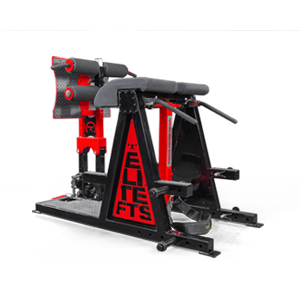
The fix is the same as his. Train the knee flexors on purpose, measure whether they're keeping up, and don't swing so far the other way that you skip the extensors. Glute ham raises and eccentric work belong in the plan, not the leftovers. Bruce Buckman's Eccentric Contractions and Hamstring Injury Prevention covers the injury side in more detail, and if you're setting up a gym, a glute ham raise is one of the best pieces you can buy for exactly this problem.
Deep Dive 4: Recovery and Knees (Kopysov, p. 78; Apel and Latan, p. 81)
Kopysov: vibromassage before and after training
From Teoriya i Praktika Fizicheskoi Kultury, 1979. Kopysov tested vibromassage at different frequencies in 12 experienced weightlifters. "Restorative" vibromassage at 10 to 15 Hz was given an hour after training for 20 minutes, mostly on the muscles that did the most work. "Tonic" vibromassage at up to 35 Hz was given right before training for 10 minutes.
After restorative massage, anxiety scores dropped from 40.3 to 33.2 points and heart rate went from 75.0 to 70.2 beats per minute. The tonic massage pushed those measures up, which he read as more readiness to train. He also stressed that how people react to it is very individual.

Then he ran it during a 30-day block before competition, with two groups of 14 matched lifters training the same volume (1650 plus or minus 90 reps a month at about 75% of max). The vibromassage group scored higher on a well-being test (81.7 versus 72.3), had fewer unutilized attempts (7.3 versus 26.4), and got better expert ratings from the coaches (9.2 versus 6.6 points).
Apel and Latan: how to prevent knee injuries
From Tyazhelaya Atletika, 1979. They open by saying most knee complaints in weightlifters aren't real injuries but "overstress symptoms," and a big part of them can be prevented. Their checklist:
- Keep the knees warm with the right clothing.
- Don't wear heels that are too high, in lifting shoes or everyday shoes.
- Warm up the knees thoroughly, best on a bike, and use swing-type exercises with 5 to 10 kg weights.
- Feet at medium width and parallel, so the joint is loaded evenly.
- Don't drop into the bottom of the squat too fast. Avoid the "collapse."
- Don't put two exercises that drop into a low squat back to back. Put pulls or general strength work between them.
- After training, do light "recovery exercises," then a hot bath or sauna. Long walks after heavy barbell work are not recommended.
What it looks like in the gym today
Vibromassage in 1979 is the massage gun in your gym bag now. The study is small and the numbers are what they are, but the way they used it is smart: short and fast before training to wake things up, slower and longer after to calm down. A massage gun or a foam roller covers most of it.
The knee list could be posted in any powerlifting gym today and nobody would argue. Keep the knees warm (that's half of what a good knee sleeve does), warm up before the bar comes out, control the descent, and think about exercise order. If your knees are already talking to you, Dani LaMartina's Troubleshooting Knee Pain While Squatting is the next thing to read.
What they got right, what didn't age well
Got right: Most of the year should be medium. Big weeks are rare and planned. Volume and intensity don't have to rise together. A coach's hands and a short cue can fix what a demo can't. The weak link limits the chain, and the answer is balance, not just more of the small stuff. Warm knees, a controlled descent, and smart exercise order prevent a lot of problems.
Didn't age well: The samples are small (12 lifters in two of these studies) and the papers are condensed, so a lot of the method is missing. The rep bands are for elite Soviet weightlifters, not a powerlifter training four days a week. Some of the hands-on cues, like slapping a lifter on the back, need a conversation first today. And vibromassage wasn't tested against a placebo, so treat the numbers as a lead, not proof.
5 Actionable Takeaways from June 1980
1. Make most of your weeks medium
Chernyak recommended 21 medium weeks a year, 13 heavy, 3 superheavy, and one stress week. Plan the boring middle first, then place the hard weeks on purpose.
2. Don't stack high volume and high intensity
Their most common pairing was medium volume with medium intensity. Heavy volume with high intensity got 2 to 3 weeks a year. When one goes up, let the other come down.
3. Count your lifts
You can't place your weeks if you don't know what they look like. Count your main lifts and close variations for a few months and see where you really are.
4. Coach with your hands and one cue
Name the error, show the position, put the lifter in it, and give one short cue. Ask first, then let them feel it.
5. Find and train your weak link
Yushkevich's best sprinters had the closest balance between extensors and flexors. Train your hamstrings like they matter, and take care of your knees before they hurt, not after.
What I keep coming back to with these issues is how plain it all is. Count the work. Spread it out. Fix the position. Train what's weak. Take care of the joints. None of it is a secret, and that's exactly why most people skip it.
How hard should this week be? Why doesn't the lifter get the cue? Why did the hamstring go? Same questions we argue about now. We'll keep going through these issues one at a time.
Live, Learn, Pass On.
Dave Tate
elitefts
Go to the source
If you want to go deeper on how the Soviets planned training, start with Supertraining, Secrets of Russian Sports Fitness and Training, and Soviet Sport Methods. For the weak links, check out the elitefts GHR and our PR knee sleeves.