
Smart & Crippled:
The Performance Longevity Playbook
Specialty bar taxonomy, 16-week periodization, and the hard rules for staying on the platform when your body has the mileage of a 1983 pickup truck.
There comes a point in every high-performance strength athlete's lifecycle where you have to stop training like a meathead and start training like a professional. The objective shifts from moving weight at any cost to a single governing philosophy: smart and crippled beats fat and stupid every time.
This isn't about backing off. It's about strategic efficiency. If you've spent thirty years on the platform, your shoulders are likely shot and your back has a memory of every heavy rep you've ever taken. Transitioning to high-efficiency training means selecting equipment that lets you keep pushing maximal loads without the high-wear cost that sidelines lesser lifters.
I don't care if you're 25 or 65 — if you don't have those nerves and that focus the moment you step under the bar, you aren't training. You're just exercising.
Shoulder health is the primary bottleneck in long-term squatting. The strength of your legs and posterior chain will almost always outlast the external rotation of your shoulders. Prioritizing shoulder-sparing equipment isn't a compromise — it's a tactical maneuver. By the time most lifters realize they need a specialty bar, the damage is done. A master coach anticipates this.
Specialty Bar Taxonomy: Strategic Selection
In a true conjugate system, bar selection is your primary lever for manipulating the center of gravity and joint stress. We don't change bars for variety — we change them to force the body to solve new mechanical puzzles. The geometry of the bar dictates how the load sits on your frame, which dictates how you brace, drive, and survive the transition out of the hole.
Comparative Analysis
| Bar Type | Hand Placement | Primary Benefits | Mechanical Impact |
|---|---|---|---|
| Giant Camber Bar | Ultra-Wide — hands drop low and wide | Maximum shoulder sparing; preserves rear delts and bicep tendons | The "stability shake" forces extreme tension in the core and hips |
| Safety Squat Bar | Front-Loaded — handles sit on the chest | Total shoulder relief; shifts load forward to challenge upper back | Forces upright torso; punishes any forward lean |
| Bow Bar | Moderate — slight curve mimics straight bar grip | Bridge between specialty and competition bars | Reduces shoulder bite while maintaining competition specificity |
| Straight / Bulldog Bar | Specific — narrow external rotation | Competition standard; maximum meet specificity | High joint cost — causes shoulder regression after 21 days of use |
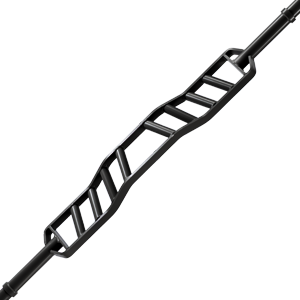
The defining feature of the Giant Camber Bar — the real one, not the narrow rackable versions that pin you into a tight spot — is its width. It allows the old and crippled lifter to get their arms out far enough to actually set a shelf without agonizing pain. More importantly, it introduces the stability shake.
 Performance Longevity — Bar Selection in the Conjugate System
The 16-Week Periodization Model
The 3-Week Wave
A phased approach to bar rotation is the only way to manage systemic fatigue and prevent the nervous system from flatlining. By rotating implements every three weeks, you avoid accommodation and keep chasing new PRs on different bars. The model moves from the most forgiving geometries to the harsh reality of the competition bar.
Weeks 1–6
Weeks 7–10
Weeks 11–13
Weeks 14–16
During early phases, not walking out is a strategic choice for the efficient lifter — it preserves the movement's focus. As the meet approaches, walk out every set to mirror federation requirements and lock in your platform balance.
Equipment Integration & Technical Execution
Integrating single-ply suits early in the cycle isn't about ego — it's about data collection. You need to know how the gear changes your leverage. One of the most critical coach's secrets for geared lifting is the "measure of death" — the point where the suit's pressure on the bladder becomes so intense you feel like you're going to piss yourself. That pressure is your definitive indicator for depth. If you don't feel it, you aren't deep enough.
Technical Imperatives for the Squat
- Driving the Head: The first movement out of the hole isn't the hips — it's an aggressive upward drive of the head to set the trajectory.
- Filling the Box: Stay upright and slide into the bar. If you can't fill the box with tension, you'll lose the suit's pop.
- The Serratus-Oblique Tie-In: Bracing is not just "big air." It is the relationship between the serratus and the obliques. Tying these muscle groups together creates a rigid, unbreakable column that protects the spine and transfers power from the floor to the bar.
- Managing the "Diaper": If your suit is too loose, it feels wiggy and unstable — the diaper effect. You need enough tightness to provide stability without being so restrictive that you can't reach the measure of death.
Strategic Summary for the Professional Coach
The hallmark of a master coach is the ability to balance a fun-driven atmosphere with a disciplined, cold-blooded framework. Powerlifting is a grind — if you aren't having fun, jumping into a meet just to see what happens or irritating the record-holders, you won't last. But that fun must be built on an iron-clad foundation of periodization rules.
Key Takeaways for Athlete Longevity
- The 21-Day Straight Bar Limit: Never use a standard competition bar for more than three consecutive weeks. Any longer and shoulder regression begins — and your performance follows.
- Width is the Weapon: Utilize a true Giant Camber Bar for its width. Giving the athlete room to drop their hands is the most effective way to keep an old and crippled lifter in the game.
- The Stability Shake as a Stimulus: Embrace the oscillation of the cambered bar. It is the most effective tool for teaching the hip-forward transition above parallel — the universal sticking point for the squat and deadlift.
Success is measured by the total you put up on the day. Greatness is measured by the number of years you're able to keep shipping it.
The coach's role is to act as the architect of this balance — ensuring the athlete hits the platform with maximum intensity and a body that isn't falling apart.
Watch: Performance Longevity — Specialty Bar Training
elitefts — Education | Powerlifting | Program Design