

THE BEGINNER SERIES: THE LIFT-OFF.
By Eric Maroscher
In the world of powerlifting, there are many factors within your control: perfecting your technique, maintaining consistency in your training, staying fully engaged in your program, prioritizing proper nutrition, and valuing recovery as much as the time "under the bar."
Yet, ironically, some of the most impactful variables on meet day are the ones you have the least control over.
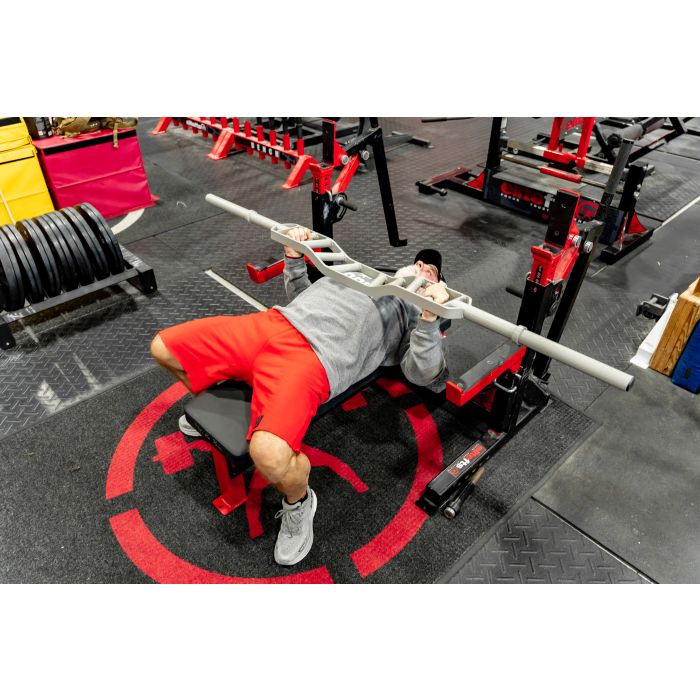
That's why, in this installment of the "Beginner Series," we're turning our focus to one critical yet often overlooked variable in the bench press: the lift off. While other aspects of powerlifting technique, such as nutrition and recovery, are firmly within your control, the lift-off is one factor that's often left to chance. Over the course of my decades in the sport as a competitor, coach, and gym owner, I've seen this issue repeatedly derail lifters, both in training and at competitions. A poorly executed lift-off can transform a potential meet-winning bench press into a missed opportunity. Worse yet, it can lead to injuries that sideline lifters, sometimes indefinitely.
For any powerlifter aiming for success, failing to address the variable isn't an option. On meet day, you're often (depending on the federation) at the mercy of someone's lift-off skills (or lack thereof), making it crucial to understand the significance of the lift-off and plan accordingly. For those of you just starting your powerlifting journey, mastering this aspect of the bench press is not just about improving your own performance; it's about ensuring you never become the reason another lifter fails or even worse, suffers an injury due to an avoidable mistake.
So, as a beginner, the question you need answered is this: How can you take control of an often somewhat uncontrollable variable?
There are a few critical aspects to lift-off that actually help the lifter, more so than just assisting them in getting the barbell off the bench uprights. Based on my decades of training, competing, and coaching experience, these five are essential.
- Communication
- Hand Placement
- Heft
- Centering over the target
- The perfect release
As the song goes, “Let’s start at the very beginning, a perfect place to start.” Before a hand even touches the loaded barbell, the lifter must establish a firm, non-negotiable rule: communicate clearly and specifically with the person providing the lift-off. Avoid the vague, casual exchange that goes something like, “Hey, can you give me a lift?” followed by, “Oh sure,” as the lift-off person hastily yanks the bar from the uprights, dumps it into the lifter’s unprepared hands, and scurries off to post their own lifts on socialookatmedia. Clear communication is key to ensuring both safety and success under the bar.
1. Communication:
Effective communication starts long before a finger touches the barbell. It’s about establishing a clear, mutual understanding of how the lift-off will happen, down to the smallest detail. Am I, as the lifter, counting "1, 2," then signaling the lift-off? Is the person assisting me taking the lead with the count? Are we doing "1, 2, 3, lift," or maybe "1, 2, lift"? Perhaps it’s "1, 2, 3, big air, then lift"? These specifics matter; they’re the foundation of a smooth, safe, and effective lift-off.
Think of it like the classic scene in Lethal Weapon 2, where Riggs and Murtaugh debate the exact timing before pulling Murtaugh off the toilet rigged with a bomb. That moment of synchronized action. That’s the level of precision you want when benching at the meet, as there is a bomb we are trying to avoid there as well.
The point being; you’re deeply invested in your lift, but the person giving you the lift-off, whether at a meet or in the gym will never-ever share your same level of commitment. Unfortunately, this crucial step in communication is often overlooked until it’s too late. Bottom line is that this is incumbent on you to ensure both of you are on the same page with a clear, agreed-upon plan before the lift-off. While there’s an entirely separate set of considerations, and even more requisite communication for a three-person lift-off with the truly big weights, that’s a story for another time. For now, as a beginner, focus on mastering this fundamental one-on-one communication. Failing to communicate effectively isn’t a matter of if it will come back to haunt you; it’s a matter of when. That is and always will be the nature of powerlifting. Anyone who tells you differently simply has not been around long enough, or they have never pushed extreme weights, end of story.
2. Hand Placement:
Hand placement during a lift-off is a critical detail that is often overlooked but carries significant consequences for both safety and optimal performance. A poorly chosen grip, like the double underhand grip, not only compromises the quality of the handoff but can also lead to serious outcomes.
Many of us, perhaps you included, have witnessed scenarios where a double underhand lift-off quickly turns into a double underhand spot when the lifter immediately begins to fail the lift. This grip leaves the lift-off person vulnerable, particularly if the lifter experiences a sudden failure or, worse, an instantaneous pec injury. For those who haven’t seen this happen yet, it’s only a matter of time. When the lifter fails under a heavy barbell, whether it’s 300, 400, 500, or more pounds, the double underhand grip essentially forces the spotter into attempting to curl the bar off the lifter.
This sudden, instinctive action places inordinate strain on the biceps, significantly increasing the risk of tearing the biceps. Skeptics of this advice often become converts the moment they hear the unmistakable, gut-wrenching sound of a pec tendon rupture. I have been witness to several and each one is an unforgettable experience and is that for anyone with longevity in the sport.
A proper lift-off should always prioritize control, stability, and the safety of both the lifter and the person assisting. Avoid hand placements that jeopardize either party, because in this sport, safety is never negotiable, and the spotters role is there for a reason.
For these reasons alone, the double underhand grip should be avoided entirely. Instead, the use of a double overhand grip or a mixed grip is far safer, but solely for the lift-off, it is also far superior. Superior in that these grips provide far greater leverage, power, and allow for much greater control of the barbell placement during that portion of the lift-off. This leads us directly into aspect three of the lift-off. And that is heft.
3. Heft:
A proper lift-off minimizes the workload for the lifter at this critical stage, conserving their energy for the press itself. This benefits both the lifter and the person assisting, as a smooth transfer of weight ensures greater stability and control. The mixed grip, also known as the double pronated grip, provides enough power for a controlled lift-off without being so forceful that it disrupts the lifter’s setup, causing them to lose back tightness or their arch.
A proper lift-off involves the proper amount of heft to get the bar off the rack, guiding it out to the lifter, and gently laying it into their hands with precision, so smooth that the lifter experiences no jarring. Few things ruin a meet attempt more than a lifter having to re-tighten their setup after an overly aggressive lift-off with too much heft, where the bar is then plopped into their hands, forcing them to waste energy stabilizing it. Similarly, an insufficient amount of heft on the lift-off, where the lifter has to muscle the bar out of the rack themselves, undermines their energy and focus.
Once the bar is off the rack, before releasing it, the lift-off person must guide it precisely to the spot over the lifter’s chest identified during the communication phase. If the bar is lifted up but not precisely positioned over the lifter’s chest, the lifter is forced to waste valuable energy and shoulder stability moving the bar into place. While manageable with lighter weights, attempting this adjustment with p.r. or third attempt amounts of weight introduces unnecessary torque on the shoulders, drains energy, and represents a fundamental failure by the person providing the lift-off. This precision of the bar’s placement over the chest is what we mean by #4: Centering over the target.
4: Centering over the target:
A plane in wartime didn’t simply drop a payload of bombs indiscriminately; they carefully aligned their approach to ensure the bombs landed precisely on target. Similarly, in powerlifting, precision is everything. Lifters come in all shapes and setups: some have long arms, while others have short ones; some lift raw, while others use an aggressive bench shirt and a wide grip. Each lifter has a unique “sweet spot,” “the groove,” the optimal position where the bar should be placed to allow for a direct descent to the chest and a powerful press when the command is given.
During the communication phase, it’s crucial for the lifter to clearly convey to the lift-off person where this sweet spot is. Precision in bar placement can make or break the lift. If the barbell is lifted too far forward, the lifter risks losing control or especially with shirted benchers, even dumping the weight. Conversely, if the barbell isn’t brought far enough out, the lifter will expend unnecessary energy just to maneuver the bar into position, potentially compromising their press.
Getting the bar placement right is like ensuring the payload hits its mark, it's about efficiency, accuracy, and setting up for the best possible outcome.
5. The Perfect Release:
Once over the target, the lifter must carefully and precisely set the loaded barbell into the person’s hands. The bar should be lifted out, moved over the lifter, and placed in position with precision. A rushed or forceful release can cause the lifter to lose tightness and control, forcing them to expend valuable energy re-establishing their grip and stability, energy that should be reserved for the lift itself.
This issue is far too common at meets, where the dynamic between the lift-off person and the head judge’s commands often results in rushed, sloppy, and ultimately detrimental lift-offs. Even experienced lifting partners, who know precisely how their lifter prefers a lift-off, can falter in the pressure to avoid obstructing the judge’s view. All too often, the lift-off person executes the initial steps perfectly, only to ruin everything with a rushed release to hurry away from the judge. The result? A sub-par handoff, with a max weight now unstable in the lifter’s grip, and a personal record attempt derailed before it even began.
As the lift-off person, it’s essential to follow these essential steps, executing a smooth lift-off with the right amount of heft, positioning the bar precisely over the lifter, and gently releasing it into their hands. So planning your exit away from the head judge in advance is critical, and it is on the lift-off person to know whether you’ll step to the right or left of the bench footplate to quickly and smoothly clear the judge’s line of sight without rushing the release. Experienced lifters often take it a step further, asking the head judge, “Do you prefer me moving to the right or left after my lift-off?” as part of their pre-lift routine while their lifter is approaching the bench. This proactive communication can make all the difference for the lifter.
The release itself is a delicate balance as it must be quick enough to avoid delaying the start command, yet controlled and smooth to prevent fumbling the lift-off. Threading this needle just right ensures the lifter is stable, in control of the weight, and ready for the judge’s start or press command, (depending on the federation).
Remember, be it a p.r. or meet max, we are talking about max effort lifts and there is no real latitude for error or the weight simply does not come up. Think about it another way, the fastest Olympic 400-meter relay races often hinge on the baton exchange as much as the collective sprinting speed of the four athletes. Even the fastest sprinters in the world won’t win gold if the baton exchange is mishandled. The same goes for the meet or p.r. Lift-off.
For you as a beginner, the bottom line is that our sport of powerlifting is a sport of dichotomies. The dichotomy of brutally explosive strength and power, and the delicacy of precision and nuance. The brutal drive to press the weight, and the surgical nuance to provide the best lift-off so your lifter has every opportunity to put their hard work and training to the test.
Throughout the entirety of your lifting journey, power and nuance will be juxtaposed against each other. It will be up to you to be the master who can balance each on a scale so that one never outweighs the other. To the contrary, these two sides of the same powerlifting coin should complement one another in a synergistic fashion.
The goal of this and the following articles in this Beginner Series is to equip you, the beginning lifter, with the nuanced knowledge and skills that enable the more brutal aspects of your powerlifting to start to emerge. Put simply, your powerlifting devil is and will always be, in the details.
Wishing you the very best in your training, meet prep, competitions and powerlifting journey. Ever onward!